
An unsettling photo of a nearly 18 foot long Burmese Python flayed open with a host of scientists poking at its innards has been accompanied by alarming headlines about snake invasions in the news this week. But the article doesn’t discuss why the python had to die, remarking simply that it was “euthanized.” The policy of euthanizing captured Burmese pythons in the Everglades has been non-controversial for a decade. The scientific consensus around the python problem was summed up in an article in Smithsonian Magazine last year: “[Everglades Wildlife Biologist Skip] Snow envisions a three-pronged program—education, prevention (keeping new exotic snakes out of the Everglades) and suppression (killing as many pythons as possible).”
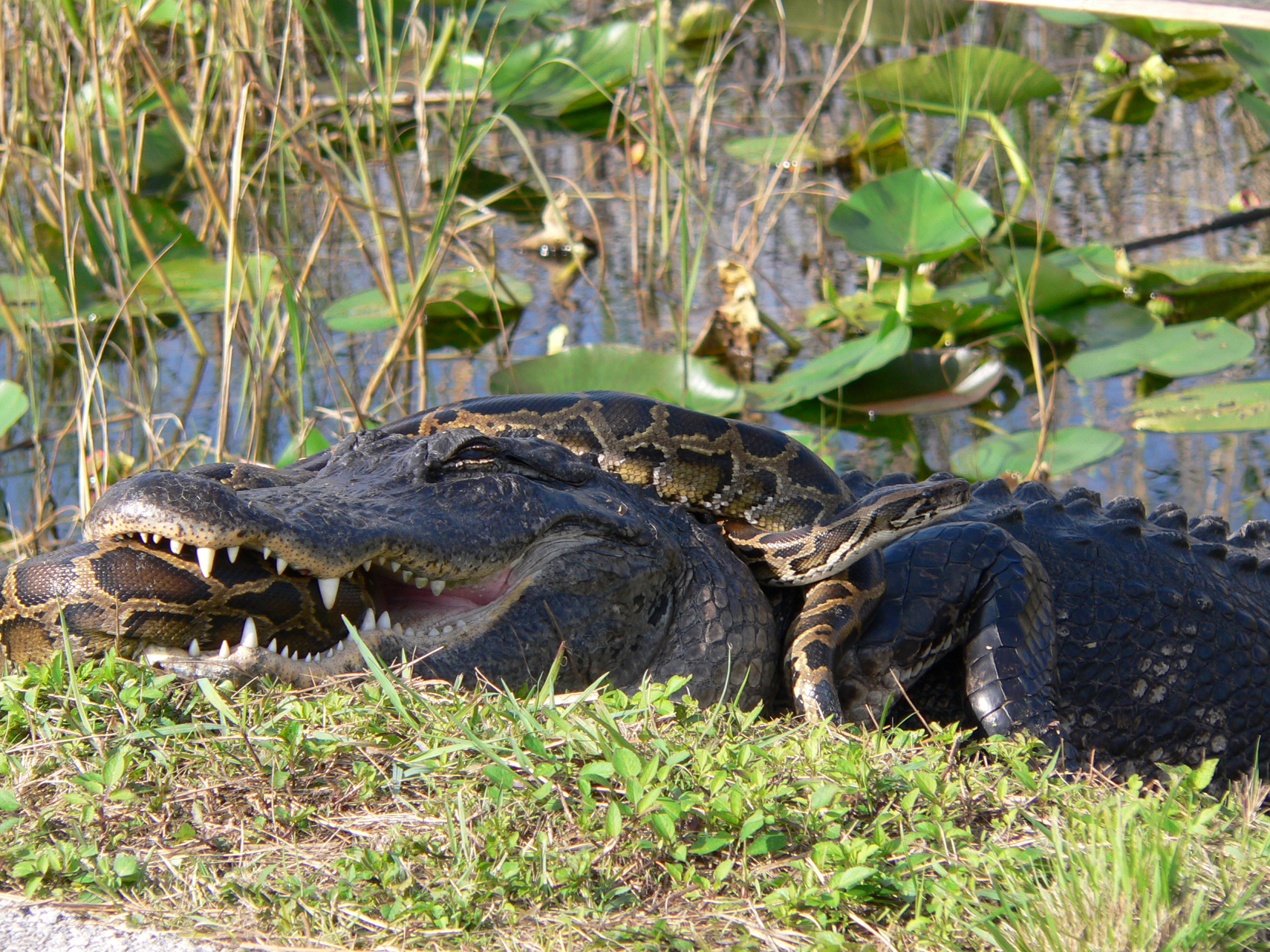
Why kill pythons? Simply put, these snakes are winning in the Everglades – eating lots and lots of animals, getting bigger, and then making more snakes – at the expense of endangered animals that live no place else on earth, in one of America’s most circumscribed and threatened habitats. In the words of Bob Reed, USGS wildlife biologist at the Fort Collins Science Center in Colorado, “Wildlife managers are concerned that these snakes, which can grow to over 20 feet long and more than 250 pounds, pose a danger to state- and federally listed threatened and endangered species as well as to humans.” Relocation is not an option; these snakes are not moving in from swamps outside of Atlanta, or swimming over from Cuba or Cancun. They’ve been flown here from Asia and distributed by pet stores. Are you willing to adopt a 15 foot long snake that can live for 20 years in captivity?
The Burmese python has a large and healthy population in South and Southeast Asia, where it is known to occasionally dine on leopards. Were a python in the Everglades to polish off a luckless Florida panther, Skip Snow could probably tell you the exact number of panthers left, and it wouldn’t be more than 200.

Burmese pythons in the U.S. are all the descendants of released or escaped pets. The Everglades has snakes of its own. They don’t eat panthers. The panthers are having a hard enough time without reptiles from half a world away lurking in the shadows for them. So we’re choosing panthers (and limpkins, and wood storks, and even the florida gator) over pythons.

 Louis Wertz
Should we not choose panthers over pythons? Is the problem that we have to choose or that we’re making a choice?
LikeLike
Thought about a final sentence along the lines of “Good choice.” Left it out because I thought it was clear enough where I stood. Maybe I should have left it?
LikeLike