
When I prepare for a hike that will start before dawn, I prepare to be cold. It does not matter if it is the height of summer or the dead of winter, or whether I’m in Kenya or Kalispell. If the sun is down, it will be cold (pro tip). So I was prepared for cold last Saturday when I blinkingly swiped at my beeping iPhone on the bedside table at 3:45am. I was prepared for it to be around freezing even, when my hiking partner Tyler and I got to the trailhead at 5:30.
But I wasn’t expecting it to be this cold.
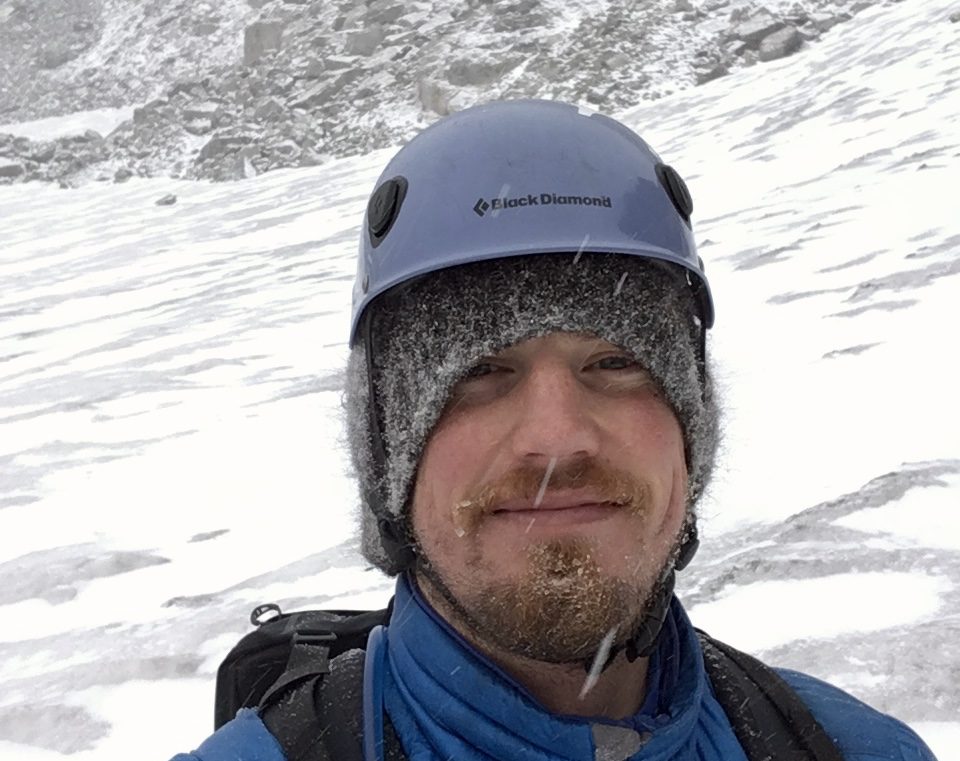
On the last weekend of September, it seems, the mountains were declaring unequivocally that summer was over. Fall was closing up shop. Winter was coming.
The rapid turning of the seasons in the high country made for a spectacular trek. In the parking lot we pulled up next to the only other vehicle, a white Nissan crusted with snow. Through our headlights on the windy road to the trailhead parking, we’d spotted patches of light snow on the side of the road. But this was our first real confirmation that it had been snowing that night, and would be snowy on the trail right from the start. We would be chasing the snow the whole day.
The sun rose in bursts, brightening and then fading as it passed over the horizon and behind a layer of thick gray cloud that now hung over the Great Plains to the east. The same thick gray cloud that had dusted the Nissan, our trail, Niwot Ridge, and our intended destination, Navajo Peak, with snow just 6 hours ago, no doubt.
We skirted the shore of Long Lake still deep in the trees and then began climbing steadily, trying our best to keep the trail despite its heavy overnight dusting and complete lack of recent traffic. Shortly after we passed the inlet to windswept and frozen Lake Isabelle and had climbed the bench at its west end the sun broke above the horizon, painting the valley of the South St. Vrain in brilliant pastels.
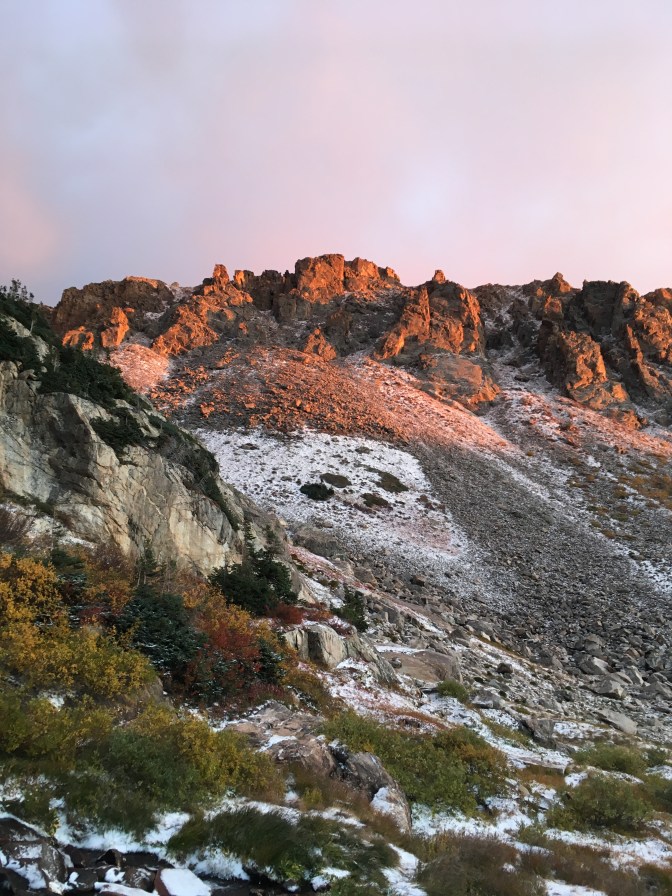
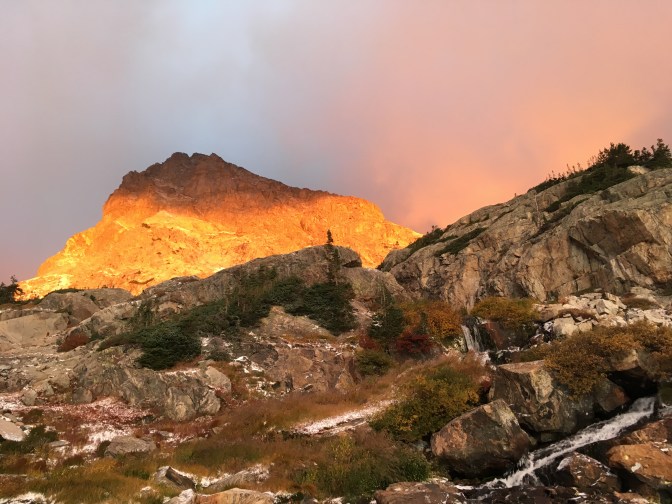
We lost the trail quickly above the bench: it was snow covered and wound its way through an alpine bog that had turned to a thicket of ice traps waiting to drench our socks. We picked a steeper but more reliable passage up a large boulder field. Pausing each time we pulled over another large block to look at the canyon walls, we discovered that the color had changed completely again. Every subtle change in angle of the sun caught a new facet of the landscape, reflecting pink, then purple, then orange, then yellow, then a brilliant gold, and then pink again, off the icy rock faces, snow-dusted scree fields, umber and siena scrub brush, and of course, the heavy storm cloud hanging over the summits to our west.
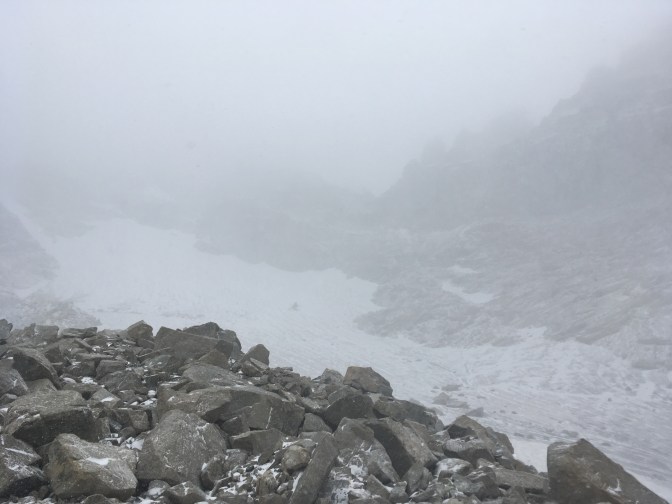
We reached Isabelle glacier an hour before noon. By then, the drama of the dawn light had ended because we were now completely enveloped by the cloud. These were not white out conditions: visibility was good enough. But the walls of the valley, the lakes below us, and the massive summits above us had been erased by suspended snow. As we picked our way along the glacial moraine at the west end of Isabelle glacier, it felt less like the snow was falling on us than like we were walking climbing up into the snow’s airspace. It had always been there: we were intruding.
After a while, that feeling actually spooked us. Our tracks disappeared behind us. I couldn’t see my breath: all the air seemed dense with frozen moisture. So, a mile and half from, and more importantly, 1200 feet below, the saddle between Navajo and Apache peaks, we called it “good enough.”
Descending, our route was surreal. It looked nothing like it had on the way up. At first, it was completely shrouded in cloud and covered in freshly fallen snow. Once we broke free of the cloud, having moved both down in elevation about 1000 feet and east three miles, just above Long Lake again, it was warm and sunny. The trail wasn’t frozen: it was mud.
And then the spell was broken: we saw another hiker. Out in jeans and a t-shirt, with a single tall walking stick and a heavy camera around his neck, he looked at us curiously. I nodded and grunted a quick “howdy.” He blinked and nodded back. It was only when we were lower and passing herds of front-rangers out on late summer jaunts that I realized how strange it must have been to see us at that moment, with our snow-dusted packs, still-frozen beanies, and half-zipped puffy jackets. All morning hiking west he wouldn’t have seen a single footprint on his way up: all of our early morning prints had melted by the time he hit the trail around ten. We had broken the spell for him: he wasn’t alone in the Indian Peaks either.

 Louis Wertz