Wired’s Matt Ridley: Don’t Panic, We Can Dig Ourselves Out of this Hole.

Wired, it should be obvious if you’ve ever opened the magazine or been to the website, is a magazine for technologists. That is, for people who turn to technology to solve humanity’s problems. Or, as is the case with Wall Street Journal columnist and Wired‘s September cover story author Matt Ridley, people who believe in the omnipotence, and apparently, the omniscience, of technology.

Ridley calls himself a “rational optimist,” (it’s the title of his most recent book) which is actually an accurate description of the basic editorial position of Wired and the Wall Street Journal. As a rule, these publications are bullish on science and technology (which they would shorthand as “progress”), and dismissive or hostile toward warnings that every bacchanal brings a hangover. This idea springs directly from the sort of rational optimism Ridley speaks of. If we just stop freaking out, Ridley claims, the ur-technologist, or simply technology itself, will solve our problems. Freaking out seems to mean demanding that the government do something, though he never makes it clear what negative impacts he thinks this fretting or fear actually has. The idea of being a “rational optimist” isn’t really remarkable at all. After all, this worldview under-girds the entire apparatus of global capitalist society.

What is remarkable is that rather than use current examples of problems where political intervention in the market, spurred by all this apocalyptic thinking, is hindering solution-making (here’s one possibility), Ridley decides to use historical examples. The examples he picks all curiously undermine his point. That’s because they all demonstrate just how effective alarmist predictions can be at creating important policy changes.

Continue reading “Wired’s Matt Ridley: Don’t Panic, We Can Dig Ourselves Out of this Hole.”

Pythons are a Problem. The Responsible Answer: Kill Them.

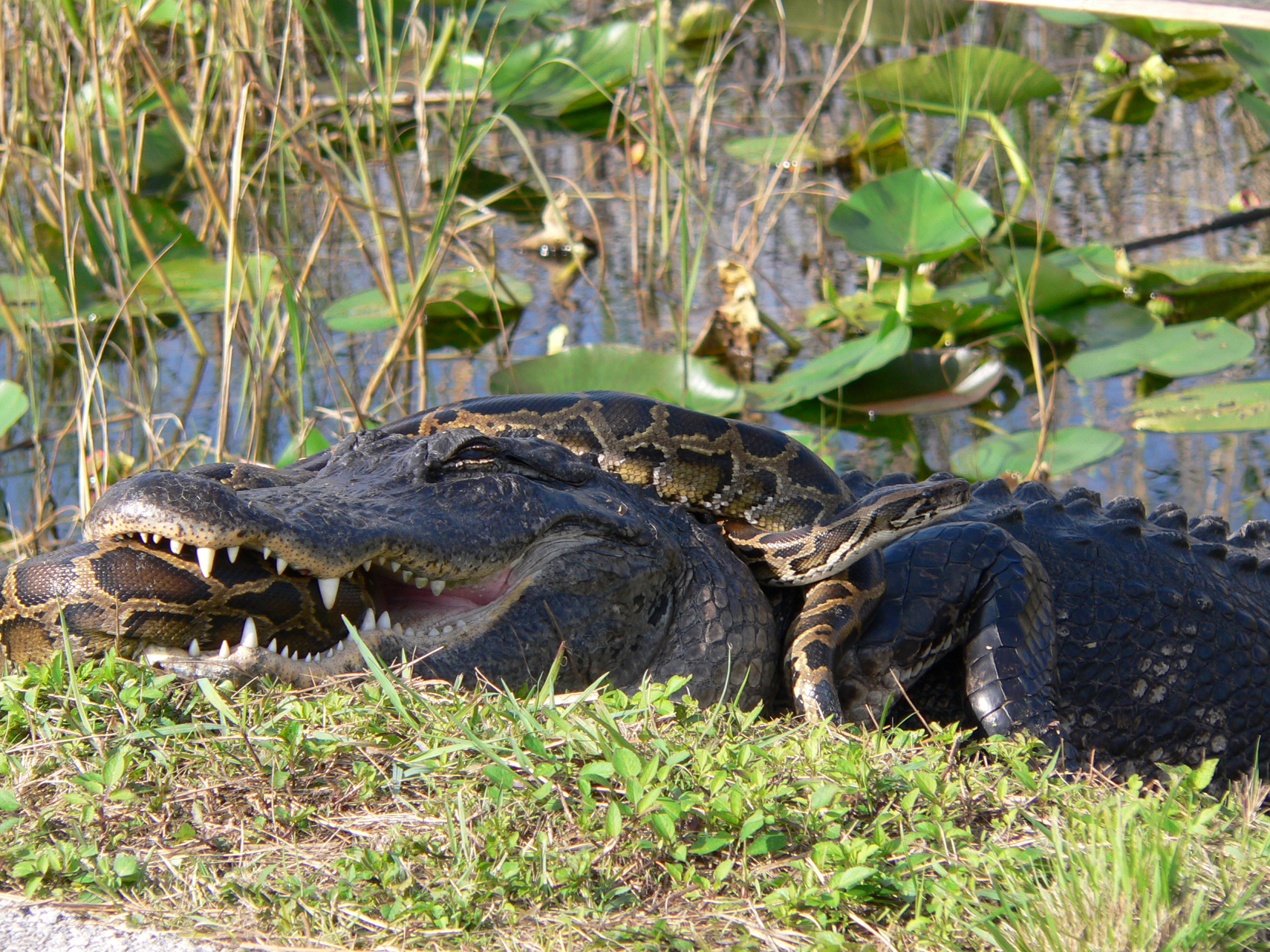
An unsettling photo of a nearly 18 foot long Burmese Python flayed open with a host of scientists poking at its innards has been accompanied by alarming headlines about snake invasions in the news this week. But the article doesn’t discuss why the python had to die, remarking simply that it was “euthanized.” The policy of euthanizing captured Burmese pythons in the Everglades has been non-controversial for a decade. The scientific consensus around the python problem was summed up in an article in Smithsonian Magazine last year: “[Everglades Wildlife Biologist Skip] Snow envisions a three-pronged program—education, prevention (keeping new exotic snakes out of the Everglades) and suppression (killing as many pythons as possible).”

from National Park Service, by Lori Oberhofer

Why kill pythons? Simply put, these snakes are winning in the Everglades – eating lots and lots of animals, getting bigger, and then making more snakes – at the expense of endangered animals that live no place else on earth, in one of America’s most circumscribed and threatened habitats. In the words of Bob Reed, USGS wildlife biologist at the Fort Collins Science Center in Colorado, “Wildlife managers are concerned that these snakes, which can grow to over 20 feet long and more than 250 pounds, pose a danger to state- and federally listed threatened and endangered species as well as to humans.” Relocation is not an option; these snakes are not moving in from swamps outside of Atlanta, or swimming over from Cuba or Cancun. They’ve been flown here from Asia and distributed by pet stores. Are you willing to adopt a 15 foot long snake that can live for 20 years in captivity? Continue reading “Pythons are a Problem. The Responsible Answer: Kill Them.”

Can Barcoded Species be Good for Science and Monsanto?

National Geographic recently featured a story about a global project, started by Canadian evolutionary biologist Paul Hebert, to “barcode” all known species.

Barcodes are derived from the CO1 gene that produces ATP, an energy carrying molecule found in  every multicellular organism on earth. The barcodes are made up of sequences of 4 colors, one for each of the DNA bases (G,T,C and A, you all remember Gattaca, right?) that make up the unique 600+ character chain of the portion of the CO1 gene that Hebert selected for its commonality. Continue reading “Can Barcoded Species be Good for Science and Monsanto?”